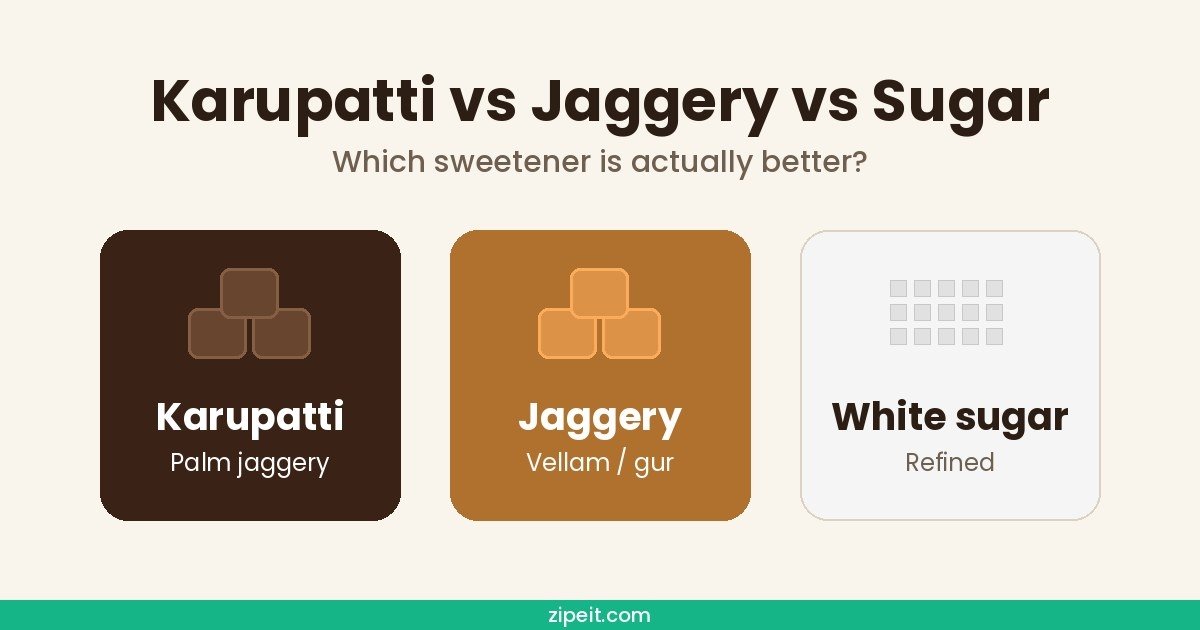



Short answer: karupatti (palm jaggery) and cane jaggery are both better choices than white sugar because they are unrefined and keep trace minerals, but all three are mostly sugar and have similar calories. Pick karupatti for drinks and Tamil sweets, cane jaggery for everyday cooking, and keep white sugar for when you need a neutral taste.
This question comes up in almost every Tamil family WhatsApp group at some point, usually with a forwarded message claiming one of them is a miracle. None of them is. But they are not the same either, so here's what actually separates them.
| Karupatti (palm jaggery) | Jaggery (vellam / gur) | White sugar | |
|---|---|---|---|
| Made from | Palmyra palm sap (pathaneer) | Sugarcane juice | Sugarcane or beet, refined |
| Processing | Boiled and set, nothing added (traditional) | Boiled and set; some makers add clarifying chemicals | Refined, filtered, bleached into crystals |
| Colour | Dark brown to near black | Golden to brown | White |
| Taste | Smoky, caramel, slightly salty | Sweet, molasses-like | Plain sweet |
| Minerals | Trace amounts kept | Trace amounts kept | Practically none |
| Calories | Similar to sugar | Similar to sugar | About 4 kcal per gram |
| Blood sugar impact | Raises it; treat as sugar | Raises it; treat as sugar | Raises it |
| Best for | Coffee, panakam, kozhukattai, payasam | Daily cooking, pongal, chikki, sambar balance | Baking, light desserts, neutral drinks |
| Price | Highest | Medium | Lowest |

The difference starts with the plant. Karupatti comes from the sap of the palmyra palm, tapped by hand from the top of very tall trees. Jaggery (vellam) is boiled sugarcane juice. That is why karupatti is rarer, costlier and darker, with a deeper, almost smoky flavour.
Both keep small amounts of minerals such as iron, calcium and potassium, because they are not refined. Neither is a serious nutrient source. In Tamil households, karupatti is traditionally considered "cooling" and cane jaggery "heating". That's a traditional belief, not something lab studies measure, but it shapes how families use them: karupatti in summer drinks, cane jaggery in winter sweets.
Somewhat, yes, and in fewer ways than marketing claims.
So the honest pitch is this: if you are going to have something sweet, karupatti is the cleaner, more traditional choice. It is not permission to have more.

Start with drinks. Replace sugar in your morning coffee with an equal amount of grated karupatti for a week. Once your taste adjusts, move to payasam and sweets. Many people find they end up using a little less, because the flavour is stronger. That is where the real benefit comes from.
Want to know how karupatti is made and how to spot a fake? Read our full karupatti guide. Ready to try it? Zippy Original Udangudi Karupatti, 500g comes from Udangudi, the GI-tagged home of traditional palm jaggery. For everyday cooking, our Zippy Organic Naattu Sakkarai (jaggery powder) is an easy swap for sugar.
Which is better, karupatti or jaggery? Both are unrefined and better than white sugar. Karupatti has a stronger, smoky flavour and is preferred for coffee and Tamil sweets. Cane jaggery is cheaper and suits everyday cooking. Nutritionally they are close.
Is palm jaggery healthier than sugar? Slightly. It is unrefined and keeps trace minerals, but it has similar calories and still raises blood sugar.
Does palm jaggery have a low glycemic index? It is often marketed that way, but reliable data is limited. It is safest to treat it like sugar.
Can I replace sugar with karupatti in all recipes? In most Indian recipes, yes, about 1:1 by weight. In baking, it adds colour, moisture and a strong flavour, so start with half.
Why is karupatti more expensive than jaggery? Palmyra sap is hand-tapped from tall palms in a short season, and production is small-scale and labour-heavy.

Zipe it draws qualitative products from emerging entrepreneurs that are hidden under the Giant Marketers' Advertising Capacity. A lot of products you have been looking for is available here at better cost & quality. Zipe it desires to be an Online Stepping Stone for budding vendors. Let's make these tiny drops into mighty ocean.